Shield of the Americas: Trump's Doral Charter Creates New Hemispheric Security Architecture
With 17 nations signing the Doral Charter, the Trump administration is bypassing traditional multilateral forums to build an ideologically aligned counter-cartel coalition — and simultaneously pushing back against Chinese influence across the Western Hemisphere.
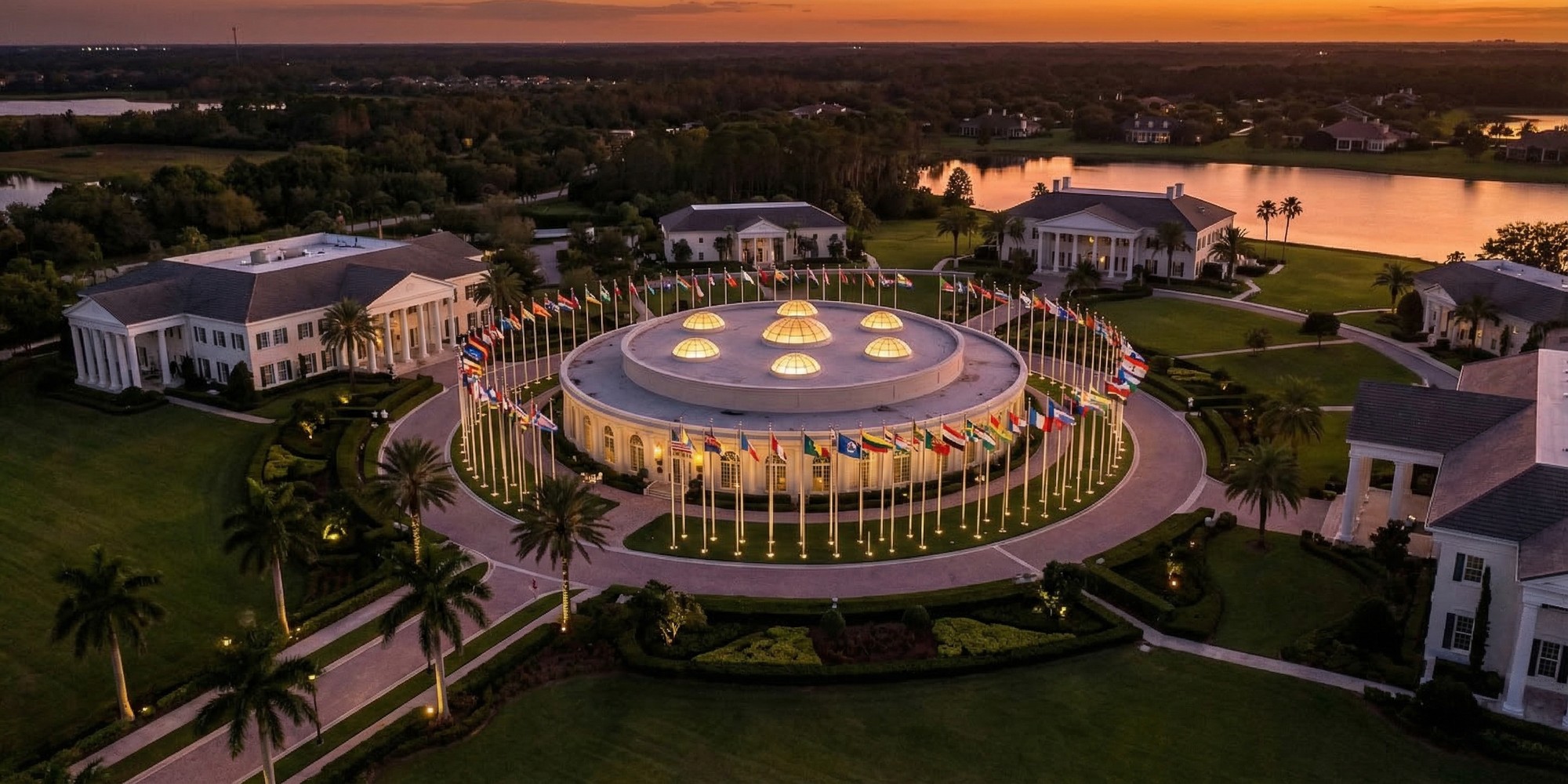
On March 7, 2026, President Donald Trump convened the inaugural Shield of the Americas Summit at his Doral, Florida golf resort, gathering heads of state from twelve Latin American nations to sign a sweeping hemispheric security declaration. The resulting Doral Charter — formally establishing the Americas Counter-Cartel Coalition — commits 17 signatory nations to expanded intelligence-sharing, joint maritime interdiction operations across the Caribbean and Pacific, and coordinated use of military capabilities to "disrupt and dismantle cartel organizations and associated terrorist networks," according to a White House readout reported by The Guardian.
The summit represents the most significant reorganization of U.S. hemispheric policy since the post-Cold War restructuring of the Organization of American States. Rather than working through established multilateral institutions, Washington is assembling what foreign policy analysts describe as a "minilateral" coalition — a smaller, ideologically aligned bloc capable of rapid coordination around shared U.S. security priorities. The composition of attendees made the strategy unmistakable: the region's three largest economies, Brazil, Mexico, and Colombia — all governed by left-leaning administrations — were conspicuously absent.
Key Takeaways
- Seventeen nations signed the Doral Charter at Trump's March 7 summit, forming the Americas Counter-Cartel Coalition with commitments to intelligence-sharing and joint maritime interdiction.
- Brazil, Mexico, and Colombia — the region's three largest economies — did not attend, exposing a deepening ideological fracture in hemispheric diplomacy.
- Former DHS Secretary Kristi Noem was immediately appointed U.S. Special Envoy to the coalition, signaling high-level institutional commitment to the framework.
- Trump explicitly framed the coalition as a counterweight to Chinese economic and political influence in the hemisphere, invoking what some observers are calling a "Donroe Doctrine."
The Doral Charter: What Was Actually Agreed
The joint declaration signed by participating nations centers on three operational pillars: intelligence-sharing architecture, maritime interdiction authority, and joint kinetic operations against cartel infrastructure. According to Politico, the framework institutionalizes security cooperation that U.S. forces have been testing operationally for months. Since late 2025, American naval and coast guard assets have conducted dozens of strikes against suspected drug-trafficking vessels across the Caribbean and eastern Pacific — operations that have already resulted in more than 150 casualties, according to reporting by NPR. The legality of those operations under international law remains contested.
Trump signed a separate presidential proclamation at the summit's conclusion establishing the coalition's formal framework and signaling that its security mandate extends well beyond counter-narcotics into broader geopolitical competition. The proclamation's language drew a direct line between cartel disruption and U.S. strategic interests in the hemisphere — an explicit articulation of what administration officials have framed as a successor to the Monroe Doctrine adapted for the 21st century.
"Just as we formed a coalition to eradicate ISIS, we now need a coalition to eradicate the cartels."
— President Donald Trump, Shield of the Americas Summit, Doral, Florida, March 7, 2026
Secretary of State Marco Rubio attended the summit and framed it as a model for how Washington intends to organize security partnerships going forward. Rubio thanked Trump for making the Western Hemisphere a strategic priority and pointedly praised the assembled leaders as "not only allies but friends" — language that drew a sharp contrast with U.S. allies elsewhere who have been slow to align with American military initiatives. In what was widely interpreted as a dig at European partners over their muted support for U.S. military operations targeting Iran, Rubio suggested the Latin American coalition demonstrated a more reliable model of allied coordination.
Minilateralism and the Absent Powers
The summit's invitation list was as strategically significant as its agenda. Present were the leaders of Argentina, Bolivia, Chile (incoming president), Costa Rica, the Dominican Republic, Ecuador, El Salvador, Guyana, Honduras, Panama, Paraguay, and Trinidad and Tobago — nearly all conservative or right-wing governments. Absent were Brazil, Mexico, and Colombia.
The absence of Mexico — the central geography of cartel operations and the United States' second-largest trading partner — creates an immediate operational tension at the heart of the coalition's ambitions. Trump publicly complimented Sheinbaum at the summit even while insisting that "the cartels are running Mexico," a characterization her government has rejected. Just weeks before the summit, U.S. law enforcement provided intelligence that enabled Mexican security forces to locate and wound Nemesio Oseguera Cervantes, known as "El Mencho," the leader of the Jalisco New Generation cartel — who subsequently died during transport to Mexico City. That operation demonstrated the operational cooperation that still exists bilaterally even as the formal diplomatic relationship remains strained.
The broader geopolitical dimension of the coalition emerged most clearly in Trump's framing of the "Donroe Doctrine" — the administration's adaptation of the Monroe Doctrine explicitly targeting Chinese economic and political influence in the hemisphere. "We will not allow hostile foreign influence to gain a foothold in this hemisphere — that includes the Panama Canal," Trump stated. The reference to the Panama Canal reflects ongoing U.S. pressure on Panama's government over Chinese port operations, a dispute that has elevated hemispheric competition to a direct U.S.-China flashpoint. The diplomatic dynamics of that broader U.S. approach to hemispheric great-power competition are analyzed in depth by Foreign Diplomacy's coverage of the U.S.-Venezuela diplomatic reset, which traces how Washington is systematically repositioning its relationships across the region.
Noem's Appointment and Institutional Gaps
Kristi Noem's appointment as U.S. Special Envoy to the Americas Counter-Cartel Coalition came hours after she formally stepped down as Secretary of Homeland Security — making her the first cabinet secretary to depart the second Trump administration. At the summit, Noem framed the coalition as a vehicle for shared sovereignty and economic security among member states.
"This is intended to be a group that works together to ensure we're defending our own sovereignty, we're each defending our own security and economic prosperity."
— Kristi Noem, U.S. Special Envoy to the Americas Counter-Cartel Coalition, March 7, 2026
The institutional architecture Noem will build remains largely undefined. The Doral Charter commits signatories to cooperation but provides no dedicated funding mechanism, no standing headquarters, and no formal dispute-resolution process. Analysts at Chatham House have noted the framework lacks provisions to address root causes of cartel power — poverty, weak governance, and corruption — and risks becoming a declaratory exercise without sustained resource commitments.
Policy Implications and the Road Ahead
The Shield of the Americas represents Washington's clearest signal yet that the second Trump administration intends to govern the Western Hemisphere through selective coalitions rather than inclusive multilateral bodies. The coalition provides a formal diplomatic architecture that bilateral agreements alone cannot replicate — and the ideological alignment of member governments should reduce friction on operational decisions. But as Foreign Policy's analysis notes, the exclusion of the region's largest democracies means Washington cannot deliver hemispheric consensus on counter-narcotics certification, extradition agreements, or port security frameworks where broader buy-in is ultimately required. The charter's maritime interdiction mandate also creates friction with international maritime law. Those operational costs carry real economic dimensions: Global Market Updates' analysis of global supply chain pressures traces how security disruptions at critical maritime chokepoints translate into tangible economic exposure.
Venezuela's position warrants particular attention. Trump's warm words for interim President Delcy Rodríguez — whose government Washington formally recognized the previous week — suggest Caracas may eventually join the coalition framework. Cuba, by contrast, was characterized as being in its "last moments," with Trump predicting imminent political change. The sequencing of these relationships will test the State Department's capacity to manage competing hemispheric incentives simultaneously.
Conclusion
The Doral Charter is more than a counter-narcotics instrument. It is a template for how the Trump administration intends to organize regional security architecture: ideologically selective, operationally focused, and linked to great-power competition with China. Whether the coalition can deliver on its stated objectives — or whether the absence of Mexico, Brazil, and Colombia renders it strategically incomplete — will depend on whether the framework evolves beyond its declaratory origins into a functioning institution with sustained political commitment from all 17 signatories. How the State Department manages that transition, and whether Noem's envoy role develops into a genuine institutional anchor, will be the variables to watch.
Related reading
- Armed Conflicts Map — Conflict briefings and theater context.