Iran War Opens Pacific Deterrence Gap
As Operation Epic Fury extends into its fifth week, INDOPACOM commanders are quietly reassessing their Pacific surge capacity — and Beijing is drawing its own conclusions from the arithmetic.
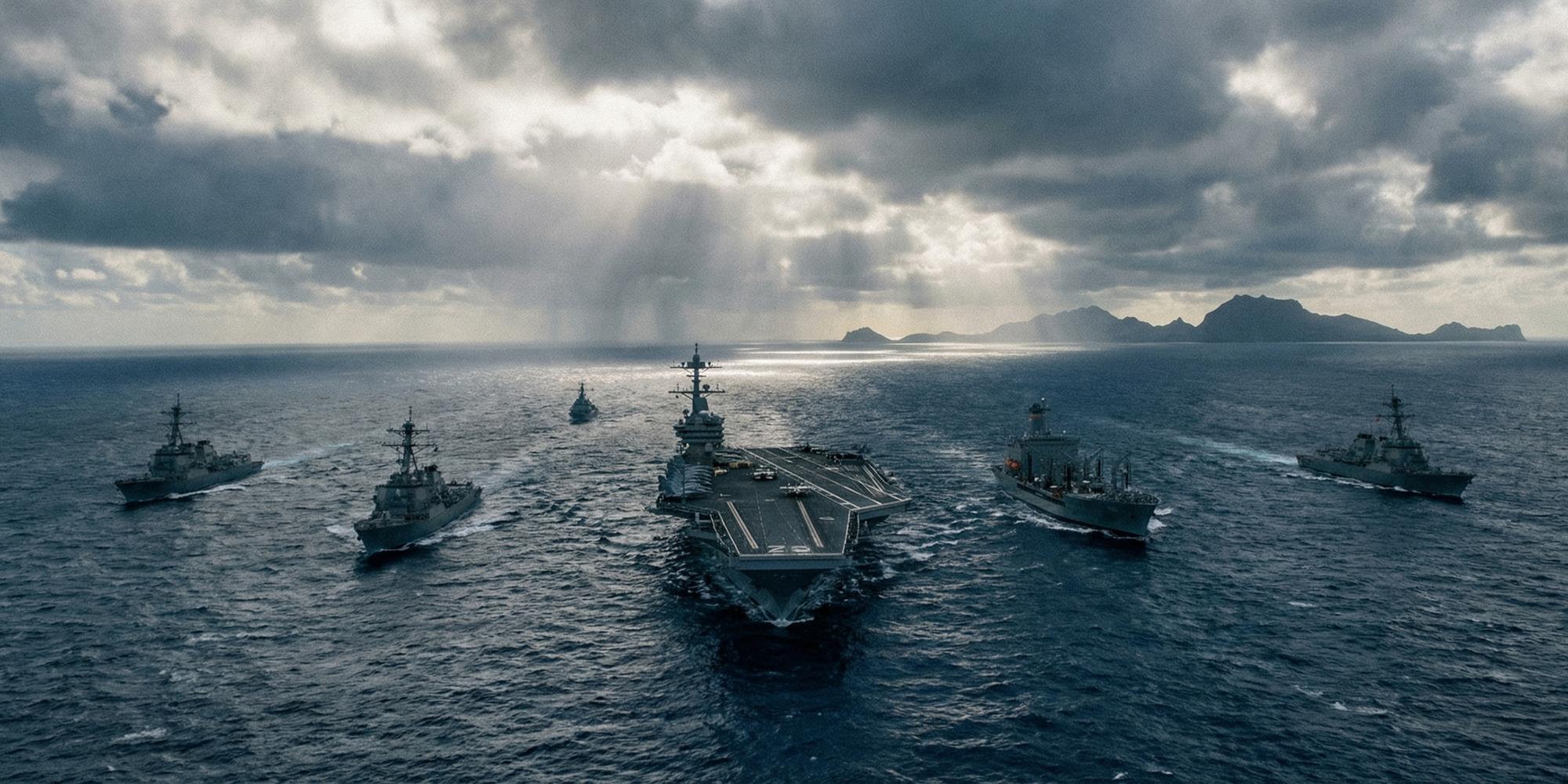
As Operation Epic Fury entered its fifth week, commanders at U.S. Indo-Pacific Command quietly updated their contingency readiness assessments — and the results make for sobering reading. With three carrier strike groups committed to the Persian Gulf campaign and precision-guided munitions stockpiles being drawn down at rates that have alarmed Capitol Hill, INDOPACOM's available surge capacity in the Western Pacific has reached its lowest point in two decades. China's People's Liberation Army is taking notice.
The strain is both operational and structural. The United States fields a military built for one major regional contingency at a time, and Operation Epic Fury has transformed that theoretical vulnerability into a live operational reality. Across the Western Pacific — in the Taiwan Strait, the South China Sea, and the Philippine Sea — allies and adversaries alike are recalibrating their assessments of U.S. reach.
Key Takeaways
- Three carrier strike groups remain committed to the Persian Gulf, leaving INDOPACOM's Seventh Fleet with a single carrier in the Western Pacific — its lowest coverage level in two decades.
- PLA Navy and Air Force activities in the South China Sea and Taiwan Strait have intensified measurably since Operation Epic Fury began in late February 2026.
- The Pentagon has activated emergency munitions production contracts, but full stockpile replenishment is 18 to 24 months away under current manufacturing timelines.
- The Iran war supplemental moving through Congress includes $4.8 billion in Pacific theater readiness provisions — the first time emergency war funding has explicitly linked Middle East combat to Pacific deterrence costs.
The Munitions and Carrier Equation
The arithmetic of two-theater deterrence is unforgiving. Under current deployment orders, the USS Gerald R. Ford and USS Dwight D. Eisenhower carrier strike groups are on station in and around the Gulf, conducting the sustained air campaign that has targeted more than 1,200 Iranian military sites since late February. A third strike group, built around the USS George Washington, was surged from its scheduled Pacific rotation in early March to bolster Gulf coverage as Islamabad-brokered ceasefire talks repeatedly stalled.
That leaves INDOPACOM's Seventh Fleet operating with the USS Theodore Roosevelt as its sole carrier in the Western Pacific. The Roosevelt is conducting its standard rotational assignments from Yokosuka, Japan, and Pacific Command officials have been careful to characterize its presence as fully mission-capable. But planners acknowledge privately that in the event of a Taiwan Strait contingency or a major Chinese move against Philippine territorial claims, INDOPACOM's ability to generate carrier aviation power on short notice would be materially constrained by the Gulf commitment.
Equally troubling is the munitions ledger. A Congressional Research Service readiness analysis released in February 2026 estimated that sustaining the current air campaign against Iranian targets is depleting Tomahawk Land Attack Missiles and Joint Air-to-Surface Standoff Missiles (JASSM-ER) at rates that leave Pacific contingency reserves significantly below planning thresholds established by the Joint Chiefs. DoD officials have declined to confirm specific inventory levels, citing operational security, but the concern has reached the Senate Armed Services Committee in classified briefings.
"We are closely monitoring our force posture globally to ensure our commitments to allies in the Indo-Pacific remain credible. One theater's demands do not supersede another's strategic requirements."
— DoD Press Secretary Maj. Gen. Patricia Frost, Pentagon Press Briefing, March 28, 2026
Beijing's Strategic Watch
American defense officials are acutely aware that Beijing is drawing its own conclusions from the Gulf campaign's resource demands. Chinese state media and PLA official channels have documented INDOPACOM's reduced carrier presence in the Western Pacific in granular detail, with outlets characterizing U.S. deployments as evidence of "strategic overextension" and warning of "dangerous miscalculations" in Washington's alliance commitments to Taiwan and the Philippines.
Since late February, PLA Navy vessels have conducted three assertive intercepts of Philippine Coast Guard ships near Second Thomas Shoal, and PLA Air Force aircraft have set a first-quarter record for Taiwan Strait center-line crossings — including six in a single 48-hour window. The passage of UNSC Resolution 2817 on Iran Gulf operations, which the U.S. supported and China abstained on in a calculated maneuver, has added fresh bilateral strain. Senior INDOPACOM officials told the Senate Armed Services Committee that the command's ability to respond to a Taiwan contingency with optimal force posture was "less than it would otherwise be" — an unusually candid admission.
Pentagon Response Measures
The Pentagon is not treating the gap as static. Defense Secretary Pete Hegseth authorized emergency production contracts for Tomahawk missiles and JASSM-ER munitions in the first week of Operation Epic Fury — commitments that Raytheon Technologies and Lockheed Martin confirmed in public earnings disclosures in March. But manufacturing timelines for precision-guided munitions mean that meaningful stockpile replenishment is 18 to 24 months away under the most optimistic production projections.
Forward pre-positioning at Enhanced Defense Cooperation Agreement sites in the Philippines is accelerating, with munitions stores at Clark Air Base and Antonio Bautista Air Base expanded under the U.S.-Philippines EDCA framework. Japan's expanding defense industrial role — co-production of Patriot PAC-3 MSE interceptors and standoff missiles authorized under Prime Minister Ishiba's 2025 National Defense Strategy — provides additional near-term mitigation. The fiscal dimension is equally constraining: as Treasury yields surge on war-supplemental pressures and analysts flag rate hike risk on $112 oil, the space for concurrent Pacific deterrence investment is narrowing precisely when demand is highest.
Policy Implications
The deeper challenge is structural. American defense planning has long assumed the ability to deter one major adversary while holding in a second theater. The Iran conflict is stress-testing that framework against actual operational demands. Congress is beginning to respond: the Iran war supplemental moving through the Senate Armed Services Committee includes $4.8 billion in Pacific theater readiness provisions — munitions procurement, infrastructure hardening at Andersen Air Force Base on Guam, and expanded joint exercises under the AUKUS and Quad frameworks. It is the first time emergency war funding has explicitly linked Middle East combat to Pacific deterrence costs.
The Reconstitution Challenge
Operation Epic Fury will eventually end — through a diplomatic settlement brokered in Islamabad or Muscat, or through military culmination. When it does, INDOPACOM will need to reconstitute its Pacific posture with urgency: restoring carrier rotations, rebuilding precision munitions reserves, and reassuring nervous allies in Tokyo, Manila, and Canberra that the coverage gap was a temporary operational constraint rather than a permanent structural ceiling. Whether those assurances carry strategic credibility will depend not on words, but on whether the defense industrial investments being authorized today can actually close the gap before 2028 — the planning horizon that INDOPACOM commanders privately describe as their most consequential deterrence window for the Taiwan Strait. That reconstitution clock exists because U.S. forces were pulled into the same 2026 Iran–US war documented on the Armed Conflicts Map's Iran–US war briefing.