The Security Council and the Iran War: Washington's Veto Strategy and Its Limits
The U.S. has blocked Russia's unconditional ceasefire resolution while marshaling 135 co-sponsors for Resolution 2817 — but operating without Security Council authorization carries long-term diplomatic costs that Washington is only beginning to calculate.
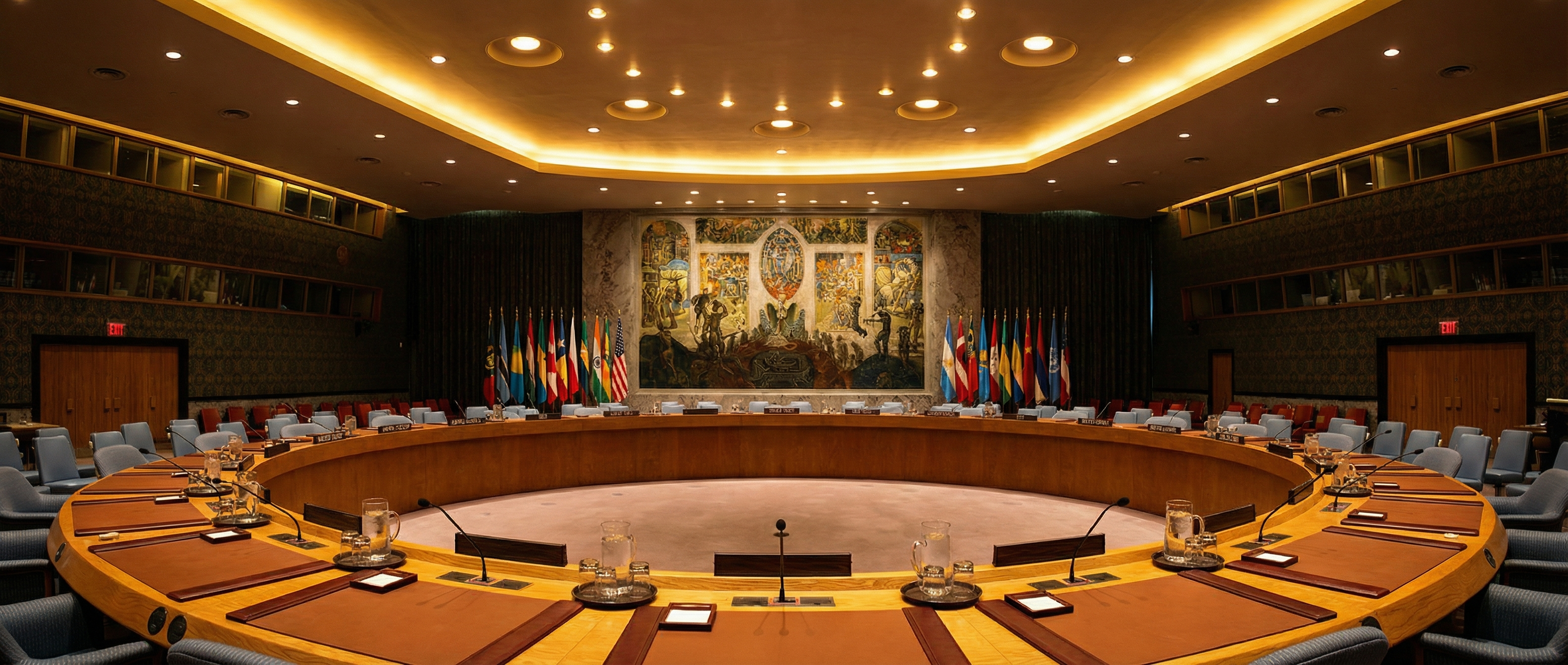
Six weeks into Operation Epic Fury, the United Nations Security Council has become a second front in America's diplomatic war over Iran — one where Washington has scored tactical wins but faces a deepening strategic challenge. The U.S. has effectively weaponized the veto to block any resolution that would frame the conflict on terms unfavorable to its military campaign, while simultaneously engineering a landmark 13-0 condemnation of Iran's retaliatory strikes across the Gulf. It is an asymmetric use of multilateral architecture: use the Council when it helps, shield it when it doesn't.
The approach has drawn sharp criticism from Russia, China, and a growing coalition of the Global South, while forcing U.S. Ambassador to the UN Mike Waltz into a delicate balancing act — defending the legitimacy of an operation that lacks explicit Security Council authorization, while arguing that American and Israeli self-defense rights under Article 51 of the UN Charter render such authorization unnecessary. As the war enters its second month with no ceasefire framework agreed, those arguments are being tested against a mounting political record.
Key Takeaways
- The U.S. vetoed Russia's draft ceasefire resolution on March 12 while securing adoption of Resolution 2817 condemning Iran's strikes, 13-0 with China and Russia abstaining.
- Russia's draft called for all parties to halt military activities and return to negotiations; the GCC-backed resolution only condemned Iran and did not address U.S.-Israeli strikes.
- No Security Council resolution has endorsed the U.S.-Israeli military campaign — Washington is operating without explicit UNSC authorization, relying on Article 51 self-defense arguments.
- Critics are exploring the "Uniting for Peace" procedure (UNGA Resolution 377) to bypass the Security Council deadlock, a move Washington is actively working to prevent.
Two Resolutions, One Divided Council
On March 11–12, the Security Council voted on two competing draft resolutions — a sequence that encapsulated the fundamental split over how the international community should respond to the conflict. The first draft, presented by Bahrain on behalf of the Gulf Cooperation Council plus Jordan, condemned Iran's retaliatory strikes against neighboring states, determined those strikes constituted a breach of international law, and demanded Iran immediately halt attacks while refraining from obstructing navigation through the Strait of Hormuz. The text was co-sponsored by more than 135 UN member states — an unusually broad showing of support. It passed 13-0, with China and Russia abstaining rather than casting vetoes, a decision that Waltz seized on immediately.
"Russia and China, sitting right behind me, had the opportunity to veto it, and they chose not to."
— Ambassador Mike Waltz, U.S. Mission to the United Nations, March 2026
The second draft, authored by Russia, took a different form entirely. Shorter and deliberately country-agnostic, it mourned the "tragic loss of life throughout the ongoing hostilities," urged all parties to immediately cease military activities, condemned attacks against civilians and civilian infrastructure, and called for a return to negotiations "without any further delay." It did not name Iran, the United States, or Israel. The U.S. vetoed the resolution, with the United Kingdom joining Washington in opposition. The vote split the Council between those who saw the conflict as Iranian aggression requiring condemnation and those who saw it as a war requiring termination — regardless of fault.
China and Russia had criticized the GCC draft during consultations as "unbalanced and confrontational," arguing it failed to address the root causes of the conflict — namely, the U.S.-Israeli strikes on Iran that initiated the sequence of hostilities on February 28. Their decision to abstain rather than veto the GCC resolution reflected a calculation that blocking a text supported by 135 co-sponsors would have been diplomatically costly. But it also reflected the limits of their leverage: Russia's own ceasefire draft failed to attract the nine votes needed for adoption, and fell to an American veto in any case.
The Authorization Gap and What It Costs
The more structurally significant fact is what did not happen: no Security Council resolution has authorized, endorsed, or retroactively sanctioned the U.S.-Israeli military campaign. Washington's legal framework rests entirely on the collective self-defense provisions of Article 51, with the U.S. citing Israel's right to pre-emptive defense against Iran's nuclear and ballistic missile programs, and the broader threat posed by Tehran's support for regional proxy forces. Iran's Ambassador Amir Saeid Iravani has countered at every Security Council session that Tehran's own actions constitute legitimate self-defense under the same Article 51 framework — an argument that has resonated with a significant portion of the General Assembly.
The gap between U.S. legal arguments and Security Council authorization matters because it shapes what allies and partners are willing to do. The 1991 Gulf War proceeded under explicit Security Council authorization (Resolution 678). The 2011 Libya intervention had a UNSC mandate (Resolution 1973). Operation Epic Fury has neither. The UK House of Commons Library, in a briefing updated as recently as April 1, 2026, notes flatly that "no UN Security Council resolution endorsing the Israel/US strikes on Iran has been passed." That formulation — technically accurate and diplomatically loaded — is being cited by governments from Paris to Pretoria as justification for withholding material support for U.S. operations. The financial pressures that flow from diplomatic isolation, including the rising risk premiums already visible in sovereign bond markets, compound the strategic cost of that isolation.
When CNN's Jake Tapper pressed Waltz on March 15 about whether the president had any timeline for ending hostilities, the ambassador's response was revealing: "I will leave it to the president where he decides and when he decides and on what terms he decides as Commander-in-chief to end hostilities." The answer was legally sound — presidential war powers are broad under the current congressional posture — but diplomatically evasive. It confirmed what Security Council members already suspected: that U.S. multilateral engagement at the UN is, for now, primarily defensive and performative rather than genuinely outcome-seeking.
The Uniting for Peace Pressure
Critics of U.S. policy have begun organizing around a procedural escape route: UNGA Resolution 377, known as "Uniting for Peace," which allows the General Assembly to convene an Emergency Special Session when the Security Council is deadlocked. The mechanism was first invoked during the Korean War in 1950 and used again during the Suez Crisis in 1956; more recently it was activated over Russia's invasion of Ukraine. If nine Security Council members agree the Council has failed to act, or if a majority of member states request it, the General Assembly can meet within 24 hours and issue recommendations — non-binding under the Charter, but politically consequential.
Washington has been lobbying against such a session, and the State Department has characterized any General Assembly resolution on the war as a step that would "reward Iranian aggression" and undermine ongoing ceasefire diplomacy through the Pakistan channel. The argument has had partial success among U.S. treaty allies. But the political arithmetic in the 193-member General Assembly is fundamentally different from the Security Council, and alliance strains — visible in Spain's recent airspace dispute — suggest that the U.S. coalition at the UN is more fragile than the 135-nation co-sponsorship figure implies. Several of those co-sponsors condemed Iran's retaliatory strikes while simultaneously calling for an end to the original U.S.-Israeli campaign, a distinction that Washington has been careful not to highlight.
Policy Implications: A Legitimacy Deficit That Accumulates
The Security Council's structural design ensures that no permanent member can be legally compelled to stop a military operation it authorizes or chooses not to submit for authorization. That much is settled law. But the political costs of operating without multilateral legitimacy are real and cumulative. They manifest in the reluctance of NATO allies to provide military support, in the difficulty of securing post-conflict reconstruction financing through multilateral institutions, and in the long-term credibility of U.S. multilateral leadership on other issues — arms control, climate finance, global health — where Washington needs institutional goodwill it is currently spending down.
Ambassador Waltz has argued, with some justification, that Resolution 2817 demonstrates the Security Council can still function as a vehicle for accountability. But 2817 condemned only one side's actions in a war both sides initiated — or at least both sides claim the other initiated. Whether that selective use of international institutions strengthens American credibility over the long run, or continues to hollow it out, is a question that will outlast the current military campaign by decades. The veto strategy is Council politics inside the same 2026 Iran–US war documented on the Armed Conflicts Map's Iran–US war tracker.
Related reading
- Oil Routes — Energy corridors, tanker risk, and commodity geopolitics.