Rubio Sells Hormuz Plan to Skeptical G7
At a 12th-century French abbey, Secretary of State Marco Rubio pitched a postwar Strait of Hormuz security framework to G7 allies who remain deeply divided over U.S. strategy in the Iran conflict.
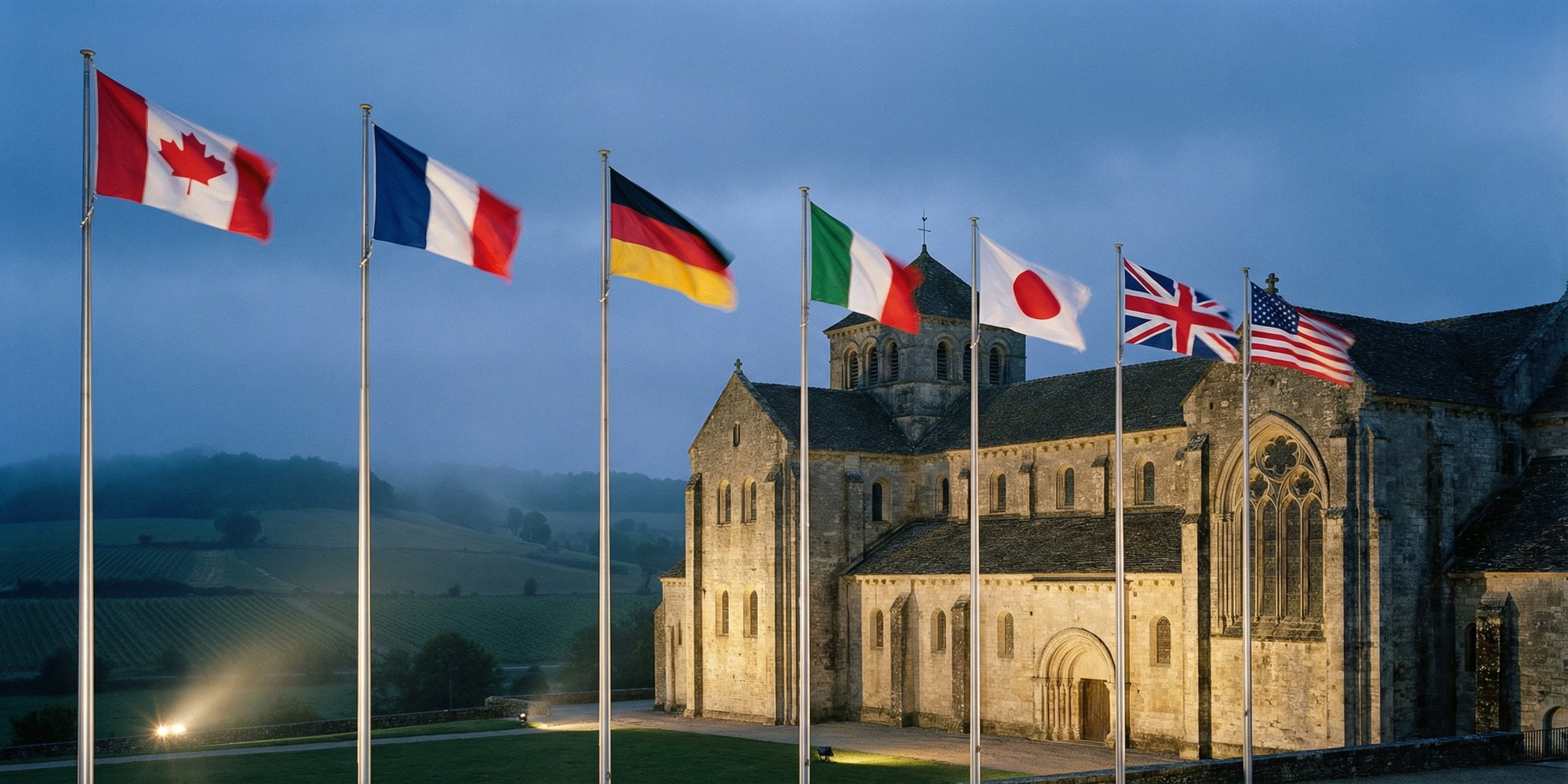
Four weeks into Operation Epic Fury, U.S. Secretary of State Marco Rubio traveled to a 12th-century Cistercian abbey outside Paris to address a problem that no air campaign can solve: persuading America's closest allies that Washington has a coherent plan for the day after. The G7 foreign ministers' meeting at Vaux-de-Cernay, France, produced a joint declaration calling for an immediate halt to attacks on civilian populations and a reaffirmation that the Strait of Hormuz must be permanently reopened to international shipping — but it also put allied divisions on stark public display.
The meeting came at a diplomatically fragile moment. A day before G7 talks opened, President Trump had delivered fresh criticism of NATO at a Cabinet meeting, declaring that the alliance had "done absolutely nothing" in the Iran conflict and accusing European partners of expecting American protection against Russia while refusing to reciprocate. Rubio's challenge was to rebuild enough diplomatic goodwill inside that same alliance to make a postwar security arrangement in the Gulf viable.
Key Takeaways
- G7 foreign ministers agreed in France to call for an "immediate cessation" of attacks against civilians and infrastructure, and reaffirmed the need to permanently restore free navigation in the Strait of Hormuz.
- Secretary Rubio presented a framework for postwar Hormuz security — including allied escort missions — but said the U.S. is "not asking for anybody to join the war."
- France stated flatly that the Iran war "is not ours"; the UK acknowledged taking a "different approach" on offensive operations; Germany said it is ready to support postwar shipping security.
- European allies expressed concern that the Iran conflict is diverting U.S. attention and resources from Ukraine, deepening a tension that now runs through every transatlantic forum.
A Framework for the Day After
Rubio's central message in Vaux-de-Cernay was forward-looking: whatever the allies' disagreements about how the war began, the strategic stakes of a disrupted Strait of Hormuz demand collective action once the shooting stops. Roughly 20 percent of the world's seaborne oil passes through the waterway; Iran has imposed what Rubio characterized as an illegal selective-access regime since the onset of hostilities, collecting tolls and selectively denying passage to vessels from disfavored nations.
"Not only is this illegal, it's unacceptable. It's dangerous to the world. And it's important that the world have a plan."
— Secretary of State Marco Rubio, press remarks, Vaux-de-Cernay, France, March 27, 2026
The postwar framework Rubio sketched envisions allied naval escort missions operating in the Strait once U.S. military objectives are achieved. French Foreign Minister Jean-Noël Barrot, who hosted the meeting, said the joint declaration "reaffirms the absolute necessity of permanently restoring free and safe navigation in the Strait of Hormuz" and noted that escort operations "could provide the necessary security so that ship traffic can resume as quickly as possible." German Foreign Minister Johann Wadephul signaled Berlin's readiness to "play a role after the end of hostilities when it comes to ensuring the security of shipping in the Strait of Hormuz" — a carefully bounded commitment that stops well short of endorsing current operations.
The economic pressure to get the strait reopened is real. Energy markets have absorbed months of disruption, and the spillover effects on inflation have weighed on growth forecasts across the G7 economies. The Federal Reserve's recalibration of its rate trajectory in response to the $112 oil shock illustrates how directly the waterway's closure is reshaping monetary policy across the alliance.
Allied Skepticism and Divergent Positions
Despite agreement on the declaration's language, the G7 meeting could not paper over fundamental disagreements about U.S. strategy. France has been the most direct. Minister of the Armed Forces Catherine Vautrin stated on Europe 1 that the war "is not ours," describing France's posture as "strictly defensive" and emphasizing that a diplomatic path "is the only one that can guarantee a return to peace." Several EU governments have noted that they were not consulted before the United States and Israel launched military operations, a procedural grievance that continues to color European assessments of the conflict's legitimacy.
British Foreign Secretary Yvette Cooper acknowledged the alliance gap without directly criticizing Washington. "We have taken the approach of supporting defensive action, but also we've taken a different approach on the offensive action that has taken place as part of this conflict," Cooper told reporters — a formulation that reflects London's careful effort to maintain special-relationship optics while declining to endorse the offensive campaign.
The widening transatlantic rift extends beyond Iran. European partners at the G7 expressed concern that the new Middle East conflict is diverting U.S. attention from Ukraine, where a unilateral U.S. decision to ease Russia oil sanctions has already opened the deepest fracture in the transatlantic alliance since the 2003 Iraq War. Germany's Wadephul made explicit that "there must be no cuts when it comes to maintaining Ukraine's defense capability" — a direct hedge against the possibility that Washington's strategic attention and resources will be stretched thin by two simultaneous crises.
The NATO Credibility Problem
Trump's remarks at a Cabinet meeting on March 26 — "We are very disappointed with NATO because NATO has done absolutely nothing" — arrived in allied capitals as Rubio was attempting to rebuild exactly the multilateral trust those remarks erode. The secretary was left navigating a structural contradiction: asking partners to commit to a postwar security architecture while the president publicly questions whether the alliance has any reciprocal obligation to the United States at all.
Rubio's response was to reframe the ask. The United States, he said, is "not asking for anybody to join the war" against Iran, but countries most affected by the Hormuz closure "should be willing to do something about it, and we'll help them." That formulation — burden-sharing framed as self-interest rather than alliance solidarity — marks a notable rhetorical shift from traditional U.S. multilateral diplomacy, and reflects the constraints Rubio operates under when presidential messaging simultaneously undercuts the alliance framework he is trying to activate.
Policy Implications
The G7 declaration represents a partial diplomatic win for the administration: it secured allied consensus on the legal principle of free navigation in the strait and achieved a joint call for civilian protection that implicitly addresses Iran's conduct. But the meeting also confirmed that Europe will not endorse the offensive campaign retroactively, will insist on a diplomatic resolution, and will condition any postwar security commitment on U.S. alignment with NATO priorities — particularly Ukraine.
For the State Department, the practical challenge ahead is converting the broad language of the Vaux-de-Cernay declaration into specific commitments: escort mission rules of engagement, burden-sharing arrangements, command structures, and a shared definition of the post-hostilities period. The administration's April 6 deadline on Iran's power plant infrastructure adds urgency; if that deadline passes without resolution, alliance tensions over escalation are likely to intensify further, complicating Rubio's already difficult task of keeping the G7 coalition aligned on the endgame.
Conclusion
The Vaux-de-Cernay meeting produced a document but not a strategy. G7 allies agreed on the outcome they want — an open strait, civilian protection, a diplomatic conclusion — without endorsing the military path Washington has chosen to reach it. Rubio's postwar Hormuz framework is conceptually sound and has found traction in Berlin and Paris as a post-hostilities task, but it depends on a shared understanding of when "post-hostilities" begins — a question that remains entirely in Washington's hands. Until the administration provides a clearer definition of its war aims and off-ramps, allied skepticism is likely to persist as the default European posture, limiting both the scope and the durability of any multilateral security arrangement the State Department can assemble. Rubio's G7 pitch is postwar diplomacy over the same strait crisis recorded on the Armed Conflicts Map's Strait of Hormuz crisis page.
Related reading
- Oil Routes — Energy corridors, tanker risk, and commodity geopolitics.