Senate Demands Iran War Clarity as Sanctions Relief Triggers Bipartisan Alarm
Five senior Senate Democrats with oversight jurisdiction across foreign policy, armed services, intelligence, and banking jointly challenged the Trump administration's decision to ease Iran oil sanctions — while the War Powers clock advances toward its statutory threshold.
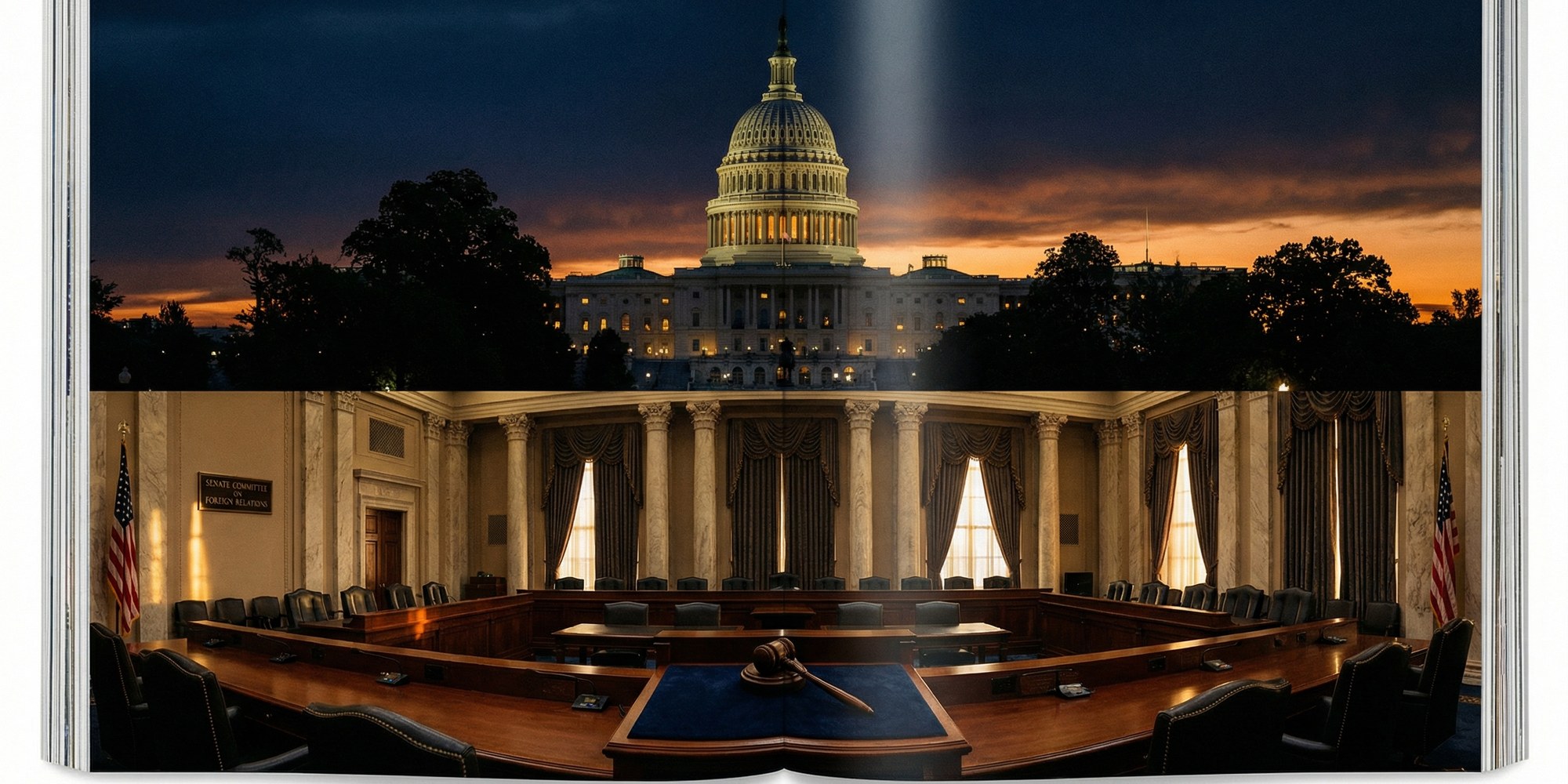
As Operation Epic Fury approaches its one-month mark, congressional oversight of the Trump administration's Iran war strategy is sharpening into an institutional challenge. Five senior Senate Democrats issued a joint statement on March 26, 2026, calling the administration's decision to ease Iran oil sanctions while simultaneously waging war against the Islamic Republic "incoherent" — and demanding that Americans be told how such a combination enhances U.S. national security.
The statement was issued by Senators Jeanne Shaheen (D-NH), ranking member of the Senate Foreign Relations Committee; Chuck Schumer (D-NY), Senate Democratic Leader; Jack Reed (D-RI), ranking member of the Senate Armed Services Committee; Mark Warner (D-VA), vice chairman of the Senate Select Committee on Intelligence; and Elizabeth Warren (D-MA), ranking member of the Senate Banking, Housing and Urban Affairs Committee. Their combined jurisdictions span the Senate's principal oversight apparatus for foreign policy, military operations, intelligence, and financial sanctions — a coordinated institutional signal that scrutiny is intensifying across multiple channels simultaneously.
Key Takeaways
- Five Senate Democrats with jurisdiction over foreign policy, armed services, intelligence, and banking jointly condemned Iran oil sanctions relief while the conflict continues.
- The senators charge that the relief opens a pathway for Chinese banks to transact with Iran's central bank, undermining the administration's own stated China containment goals.
- Iran has formalized a de facto "toll booth" regime at the Strait of Hormuz, requiring IRGC vetting of ships and collecting passage fees in Chinese yuan, per Lloyd's List Intelligence.
- House Foreign Affairs Committee held a full committee hearing on arms control and international security framework — signaling Congress is already examining a post-conflict architecture.
- The War Powers Resolution's 60-day clock is approaching, raising statutory questions about congressional authorization for continued operations.
The Senate Statement: Strategic Incoherence Alleged
The senators' critique centers on what they describe as a fundamental strategic contradiction — one that has been building since early reports of OFAC carve-outs and waivers emerged alongside the military campaign. The administration's sanctions relief, as described in the statement, appears to permit Chinese financial institutions to facilitate transactions with Iran's central bank, which the senators argue "directly undercuts the Administration's own claims that this policy would limit Beijing's role in the Iranian oil trade." The statement provides no evidence that any safeguards or transparency mechanisms govern where the resulting revenue flows.
"Waging war on a regime while simultaneously enabling it to increase oil profits by lifting sanctions makes zero sense and reaches new levels of incoherence."
— Senators Shaheen, Schumer, Reed, Warner, and Warren, Joint Statement, March 26, 2026
The statement invokes 13 U.S. service members killed in the conflict as a measure against which strategic rationale must be weighed. It also points to rising domestic gas prices, connecting congressional oversight to the lived experience of American constituents in a midterm election cycle. The senators call the decision "less like a plan and more like a panicked move that benefits our adversaries while leaving the American people to bear the cost."
The Hormuz Context: Iran Tightens Its Grip
The political challenge for the administration is compounded by new developments at the Strait of Hormuz, where Iran has constructed what amounts to a formalized checkpoint system — colloquially described by shipping analysts as a "toll booth." According to AP reporting based on data from Lloyd's List Intelligence and maritime tracking, Iranian communications to the United Nations maritime authority describe "precautionary measures" that have in practice created a vetting regime administered by the Islamic Revolutionary Guard Corps.
Ships transiting the strait are increasingly rerouted through Iranian territorial waters, where they submit cargo details, crew lists, and ownership information to IRGC-approved intermediaries. Approved vessels receive a code and are escorted by an IRGC vessel. At least two ships have paid passage fees denominated in Chinese yuan. Traffic through the waterway has fallen roughly 90% since March 1 — from a pre-war daily volume of approximately 150 or more vessels down to just 150 transiting the entire month. Iran's own oil export terminal at Kharg Island, by contrast, continued loading approximately 1.6 million barrels in March — largely unchanged from pre-war monthly figures — with most buyers being private Chinese refineries that operate outside U.S. sanctions enforcement.
For the senators questioning the sanctions policy, the toll booth arrangement crystallizes the contradiction they describe: Iran is monetizing Hormuz access while simultaneously collecting sanctions-relieved oil revenue from Chinese buyers, generating revenue on both ends of the export chain. The economic spillover is substantial. As analysts tracking global market conditions have noted, oil prices well above $100 per barrel are now generating serious Federal Reserve policy recalibration — a dynamic explored in depth at Global Market Updates, which has tracked the rate hike risk emerging from the Iran-driven energy shock.
House Foreign Affairs: Building the Post-Conflict Framework
While Senate Democrats focused on accountability for the ongoing conflict, the House Foreign Affairs Committee signaled a forward-looking posture in a March 25–26 full committee hearing titled "Securing the Future: Arms Control and International Security for the Modern Age." Europe Subcommittee Chairman Keith Self delivered opening remarks framing the session as an examination of how the United States should structure arms control frameworks in a security environment remade by the Iran war.
The hearing reflects a growing recognition among at least some House Republicans that the Iran conflict is not merely a near-term military operation but a structural disruption requiring new institutional arrangements — treaty frameworks, verification regimes, and post-hostilities security architecture that a future settlement would need to address. The committee also held a March 18 hearing on "Restoring Mission Focus at the State Department: Authority, Accountability, and the Role of the Foreign Service," examining whether the diplomatic corps has the capacity and authorization to manage the multi-track negotiation environment now emerging through Pakistani and other intermediary channels.
The overlap between Democratic demands for accountability on the present and Republican hearings on the future arms control landscape reflects the dual pressure the administration faces. As Foreign Diplomacy's analysis of competing ceasefire frameworks illustrates, Iran's negotiating posture remains resistant to U.S. terms, with Tehran advancing its own conditions that treat sanctions relief as a prerequisite rather than a concession — precisely the dynamic Senate Democrats are now arguing the administration has conceded in advance.
The War Powers Clock and Congressional Leverage
Underlying all of this congressional activity is a statutory reality: the War Powers Resolution of 1973 (50 U.S.C. § 1541 et seq.) requires the president to notify Congress within 48 hours of introducing armed forces into hostilities and limits unauthorized military operations to 60 days, with an additional 30 days for withdrawal. Operation Epic Fury began in early March 2026. The 60-day statutory threshold is now approaching, raising formal questions about whether the administration will seek congressional authorization, invoke emergency authority, or allow the clock to run without resolution.
The Senate's War Powers debate has already been the subject of separate legislative activity, but the March 26 Democratic statement reframes the question from procedural compliance to strategic coherence. The senators are not simply asking whether the president notified Congress — they are asking whether the mission's logic, including its sanctions architecture, is defensible enough that Congress and the public can evaluate it as a coherent whole.
Policy Implications: Oversight Levers and Institutional Signals
The five senators' committee assignments give them tools beyond press statements. The Senate Banking Committee — where Warren serves as ranking member — has jurisdiction over OFAC and the Treasury Department's sanctions architecture, meaning any formal expansion or modification of Iran sanctions relief has a committee vector for hearings and investigation. Reed's Armed Services Committee position carries authorization and appropriations authority that could, under the right political conditions, be used to impose conditions on continued military operations. Warner's intelligence committee role provides access to classified assessments of the sanctions relief's strategic impact — information that could be used to formally challenge the administration's public justifications.
None of these levers has been triggered. But the joint statement, coordinated across five committees that collectively span the full oversight architecture of U.S. foreign and security policy, is a formal institutional signal that the conditions for continued congressional acquiescence are being examined. The administration now faces an accountability burden: explain the strategic logic of waging war on a regime while simultaneously easing the sanctions pressure that has long been Washington's primary non-military tool for constraining Iranian behavior.
Conclusion: Congress Enters the Debate
At the one-month mark of the Iran conflict, Congress is no longer simply watching the war unfold. It is building the oversight record — through Senate statements, committee hearings, and approaching statutory deadlines — that will define how this conflict is adjudicated in the national security policy ledger. Whether that accountability effort produces legislative action or remains at the level of political pressure will depend on how the administration responds to the growing demand for a coherent, publicly defensible account of its Iran strategy. That oversight fight is Congress arguing over the same Iran–US war documented on the Armed Conflicts Map's Iran–US war tracker.
Related reading
- Oil Routes — Energy corridors, tanker risk, and commodity geopolitics.