American Bases Under Fire: The State Department's Gulf Alliance Test
Iran's missile campaign has struck every major U.S. installation across the Gulf region, forcing a fundamental recalibration of how Washington manages its most strategically critical partnerships.
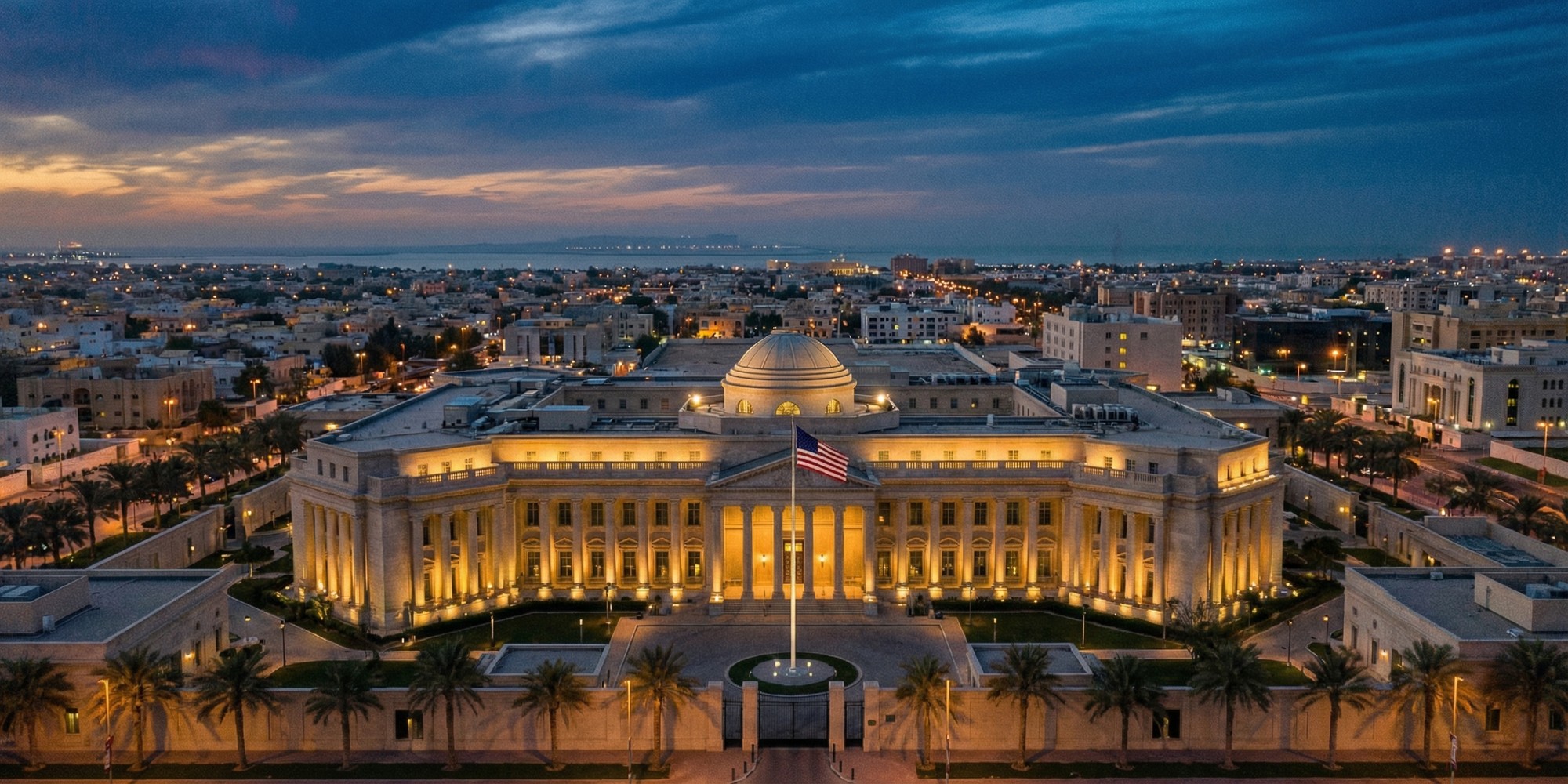
When Iran launched its initial retaliatory strikes on the night of February 28, 2026, it targeted not only Israeli and American military assets but also the network of Gulf Arab states that host the physical infrastructure of U.S. power in the region. Within hours, Al Udeid Air Base in Qatar — home to the largest American air operations hub in the Middle East — came under ballistic missile and drone attack. The U.S. Navy's Fifth Fleet headquarters in Bahrain, Al Dhafra Air Base in the United Arab Emirates, and Ali Al Salem Air Base in Kuwait each received incoming fire. Iran had drawn a deliberate map: every country that quietly underwrites American military presence in the Gulf was now a declared target.
More than a week into the conflict, as the war entered its second phase of attritional exchanges, the State Department faces a challenge that cannot be resolved by air power or naval dominance alone. The Gulf Cooperation Council states — long the bedrock of U.S. strategic posture in the region — are being asked to sustain an alliance they never formally endorsed entering, while absorbing attacks they explicitly warned Washington they sought to avoid. Managing that relationship, and preventing the Gulf from slipping into a posture of armed neutrality, has become the most acute test of American diplomatic architecture in the region since the 1991 Gulf War.
Key Takeaways
- Iran struck every major U.S. base in the Gulf region — Al Udeid (Qatar), the Fifth Fleet (Bahrain), Al Dhafra (UAE), and Ali Al Salem (Kuwait) — within hours of launching its retaliatory campaign on February 28.
- Qatar shot down two Iranian Su-24MK bombers on March 2, marking the first direct Arab state military clash with Iran — a historic shift in Gulf strategic posture driven by the scale of Iranian attacks, not Washington's diplomatic management.
- More than 1,800 Iranian missiles and drones have been intercepted in Gulf airspace since the conflict began, with hundreds penetrating defenses; Gulf states denied the U.S. use of their airspace for offensive strikes prior to the outbreak of hostilities.
- Gulf states had actively lobbied the Trump administration in January 2026 against military action, seeking renewed diplomacy with Tehran — a posture abandoned only after Iran targeted their civilian and energy infrastructure.
From Cautious Hosts to Reluctant Wartime Partners
The Gulf states entered this conflict as reluctant bystanders hoping to remain uninvolved. In January 2026, with U.S.-Iran nuclear negotiations in visible collapse, senior Gulf officials — including representatives from Saudi Arabia, Qatar, and the UAE — pressed the Trump administration to pursue a diplomatic track rather than a military one. They denied the United States permission to use their airspace and territory to launch offensive strikes against Iran, calculating that neutrality would shield them from the worst of any Iranian response.
That calculation failed on the first night of the war. Iran's targeting doctrine made no distinction between U.S. military installations and the sovereign infrastructure of the states hosting them. Iranian missiles struck the Ras Laffan liquefied natural gas complex — the source of roughly 30 percent of global LNG supply — along with Gulf airports, seaports, embassy compounds, and residential high-rises. The scope of the strikes shattered any diplomatic insulation the Gulf states had hoped their lobbying might provide.
"Gulf Arab states lobbied hard for the United States to engage in talks with Iran. Yet in the war, 1,800 Iranian missiles and drones have been intercepted in Gulf airspace, with hundreds breaking through."
— Christian Science Monitor, March 4, 2026
The turning point came on March 2, when the Qatari air force intercepted and shot down two Iranian Su-24MK tactical bombers approaching Al Udeid Air Base and the Ras Laffan complex at low altitude. It was the first time an Arab state had engaged Iranian military aircraft in direct combat — a transformation that the Foreign Policy analysis described as the realization of a decades-long American ambition: open Arab-Israeli-U.S. military cooperation against Iran, achieved not through diplomatic architecture but through the sheer pressure of Iranian aggression.
Washington's Alliance Infrastructure Under Stress
The United States has spent four decades building a layered network of basing agreements and defense partnerships across the Gulf. Al Udeid hosts approximately 10,000 U.S. service members and serves as the air operations hub for U.S. Central Command's entire theater. The Fifth Fleet headquarters in Manama provides command-and-control for U.S. naval operations from the Red Sea to the Arabian Sea. Al Dhafra in Abu Dhabi and Ali Al Salem in Kuwait provide additional forward strike and logistics capacity. These installations are not peripheral to U.S. military strategy in the region — they are its operational foundation.
Iran's deliberate targeting of these bases forced the State Department into a compressed diplomatic posture: reassure Gulf partners that U.S. extended deterrence remains credible even as their territory absorbs Iranian fire, while simultaneously pressing those partners to remain operationally cooperative rather than politically distancing themselves from the conflict. The challenge is compounded by the White House's stated position that there will be no negotiated settlement with Tehran short of unconditional surrender — a condition that leaves Gulf states with no diplomatic off-ramp to negotiate their own security.
The economic dimension of this pressure is substantial. As global markets have recalibrated to the oil shock generated by Gulf instability, the Gulf states are absorbing both physical destruction and accelerating economic uncertainty. Damage to the Ras Laffan complex, Saudi Aramco infrastructure at Ras Tanura, and Gulf port facilities has disrupted the energy export revenues that underpin Gulf state fiscal policy and political stability. A prolonged conflict that exhausts Gulf state economic resilience while offering no diplomatic horizon risks fracturing the alliance from within.
Policy Implications: The Long-Term Architecture at Risk
The deeper strategic question for American policymakers is whether the Gulf alliance network that emerged from decades of patient diplomatic investment can survive being activated under conditions its members explicitly sought to prevent. Gulf states that once viewed Iranian threat rhetoric as manageable now face the reality of Iranian missiles striking their capitals. That experience has produced tactical military cooperation — but it has also generated a new layer of political resentment toward Washington for a war the Gulf states argue could have been avoided.
As reporting on the regional dimensions of the conflict documents, Gulf leaders are already recalibrating their long-term strategic orientation — asking not whether the United States can protect them in the current conflict, but whether Washington's policy preferences can be trusted to align with Gulf security interests in the next one. That is a question the State Department will be managing long after the air campaign concludes.
Conclusion: Diplomacy After the Strike Package
The immediate operational picture in the Gulf may be defined by missile intercepts and airspace control, but the enduring policy challenge belongs to diplomats, not targeting officers. The State Department must maintain Gulf state cooperation through the duration of a conflict they never endorsed entering, reassure partners whose infrastructure is being systematically degraded, and prevent the emerging wartime coalition from fracturing under the weight of a war without a defined endpoint. How Washington handles that challenge will determine not just the outcome of this conflict but the architecture of American power in the Gulf for the decade that follows. The bases under fire that created that challenge are the same opening retaliation recorded on the Armed Conflicts Map's Iran–US war tracker.
Related reading
- Oil Routes — Energy corridors, tanker risk, and commodity geopolitics.