AUKUS Meets Shipyard Math in 2026
Washington has largely removed regulatory friction in AUKUS defense trade. The harder question is whether U.S. nuclear shipbuilding can deliver on Pillar I timelines.
AUKUS has entered an accountability phase. In its early years, the policy conversation focused on legal architecture and export controls. In 2026, the debate is shifting to production throughput, supplier capacity, and workforce constraints inside the U.S. submarine industrial base. That shift is clear in public records from the Commerce Department’s AUKUS export-control interim final rule, the State Department’s 2025 ITAR exemption update for AUKUS trade, and Senate testimony on nuclear shipbuilding performance.
The implementation challenge is straightforward but not small. Pillar I requires the United States to sustain domestic fleet requirements while supporting Australia’s pathway to conventionally armed, nuclear-powered submarines. Public testimony and Congressional Research Service analysis indicate the same strategic bottom line. Policy barriers have narrowed, but industrial constraints are now the pacing function for credibility.
Key Takeaways
- BIS and State rule changes reduced licensing and trade frictions for AUKUS-related defense transfers.
- Senate Armed Services testimony identified continuing shortfalls in U.S. submarine production tempo and supplier readiness.
- CRS frames AUKUS as an active oversight file for Congress, centered on timeline and industrial-base risk.
- For U.S. strategy, alliance credibility now depends on quarterly delivery metrics, not summit communiqués.
Rules moved first, and quickly
The policy side has advanced materially. BIS’s April 2024 interim final rule states that the department amended the EAR to remove license requirements in defined cases, expand license exceptions, and reduce end-use and end-user license burdens for Australia and the United Kingdom in support of AUKUS goals. In practical terms, that reduced one of the early bottlenecks for trilateral technology movement and industrial coordination.
Diplomatic messaging has also remained aligned across the three governments. In the December 2025 trilateral defense ministers’ statement, officials said they intended to move “full steam ahead” while prioritizing infrastructure and workforce uplift to support the submarine industrial base. Reuters similarly reported in December 2025 that a Pentagon review found opportunities to put AUKUS on the “strongest possible footing,” reinforcing that the issue had moved from whether to proceed to how to execute at scale (Reuters).
Shipyard throughput is now the strategic variable
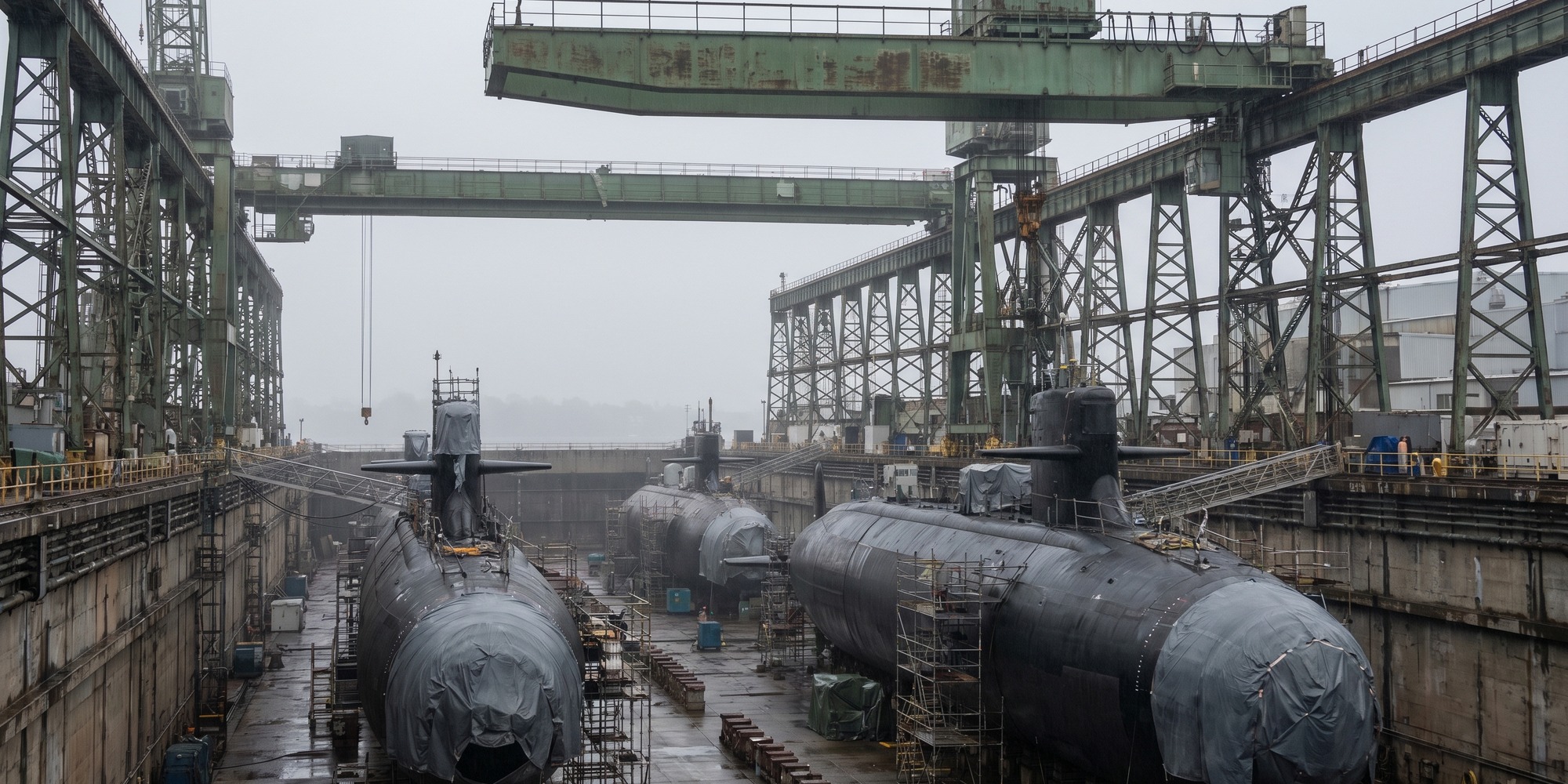
The central constraint appears in congressional hearing materials. At the Senate Armed Services Committee’s April 2025 hearing on the state of nuclear shipbuilding, Navy and industrial-base officials described a production ecosystem still adapting from lower-rate output to a much higher requirement. The hearing package and witness statements identify schedule pressure, supplier fragility, and labor pipeline stress as interlocking risks (SASC hearing page).
“The Navy, submarine shipbuilders, and supply chain enterprise underestimated the effort required to transition from the peace-dividend era, low-rate submarine production and sustainment to the increased 1+2 production needed for an era of near-peer competition.”
— Joint witness statement to the Senate Armed Services Committee, April 8, 2025
That line matters because oversight testimony describes a published production goal of one Columbia-class and two Virginia-class submarines per year by the end of 2028, before additional scale-up in the early 2030s (joint witness statement PDF). If that pace slips, AUKUS timelines face compression across training, transfer sequencing, and long-term force planning. If it holds, Washington can present AUKUS as a durable model of alliance industrial integration rather than a political commitment dependent on optimistic assumptions.
The strategic consequence is wider than one program office. AUKUS delivery confidence affects Indo-Pacific deterrence signaling, partner force planning, and allied political confidence in U.S. commitments. Related coverage at Foreign Diplomacy reflects the same pattern in regional negotiations, where implementation credibility increasingly shapes diplomatic outcomes.
Congress is treating AUKUS as an oversight file
CRS’s In Focus brief on AUKUS and Indo-Pacific security positions the partnership as an active oversight issue for the 119th Congress, with questions focused on schedule realism, industrial capacity, and execution risk (CRS IF12113). This is a notable shift from earlier years, when congressional debate concentrated more heavily on architecture and intent.
In practice, this likely means more milestone-based scrutiny: supplier on-time delivery rates, workforce retention and certification metrics, and yard-level schedule variance, not only annual topline budget hearings. It also means more pressure to align diplomatic messaging with measurable industrial outcomes. Where AUKUS is concerned, process credibility now depends on whether public commitments can be tied to verifiable production data.
Policy implications for U.S. foreign and defense strategy
First, Washington should continue pairing alliance diplomacy with transparent implementation scorecards. The strongest burden-sharing narrative is one that shows on-time hull delivery and interoperable capability, not only headline spending or communiqués.
Second, the administration and Congress should treat shipyard workforce policy as a core foreign policy input. Hiring pipelines, certification throughput, and supplier stabilization are now directly connected to Indo-Pacific deterrence credibility. Similar spillovers are visible in market-facing defense and energy risk pricing tracked by Global Market Updates and domestic policy-risk coverage at US Market Updates.
Third, U.S. interagency planning should lock AUKUS implementation milestones to recurring review points, rather than waiting for annual summit cycles. That approach would give allies and Congress earlier warning if timeline risk is compounding, and it would support corrective action before delays become structural.
Conclusion
AUKUS no longer lacks policy scaffolding. The regulatory framework has progressed, trilateral diplomatic alignment remains intact, and congressional attention is now concentrated on whether execution can keep pace with strategy. For U.S. foreign policy, the core test is clear: Pillar I credibility will be earned in shipyards and supplier networks, not in declaration language. The alliance has moved past launch politics. It is now in the delivery business.
Related reading
- Armed Conflicts Map — Conflict briefings and theater context.